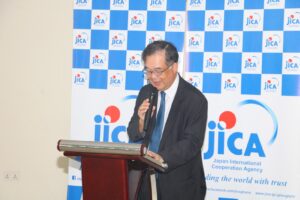
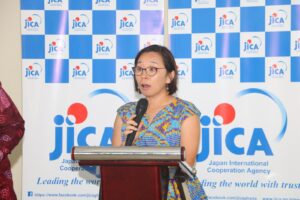
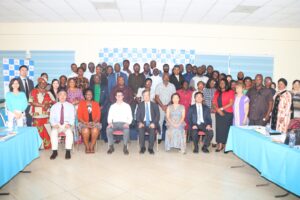
Japan International Cooperation Agency has reinforced its long-standing commitment to Ghana’s human capital development, hosting a homecoming presentation session in Accra for beneficiaries of the Project for Human Resource Development Scholarship (JDS).
The event, held at Erata Hotel on February 17, 2026, brought together Ghanaian government officials who recently completed graduate studies in Japan under the Japanese Government-funded scholarship scheme. It also featured a high-level seminar on Japan–Africa relations and Japanese corporate investment trends.
A Decade of Strategic Investment
Since its introduction in Ghana in 2012, the JDS programme has supported 143 Ghanaian civil servants to pursue postgraduate studies in Japan. Now in its 14th year, the initiative has become one of Japan’s flagship human resource development programmes in Ghana.
The scholarship equips promising public officials with advanced academic training and exposure to Japan’s development model. Many alumni now serve in influential roles across ministries and state institutions, contributing to policy reforms in Economics, Public Administration, Public Health, and International Relations.
By investing in young professionals within Ghana’s public sector, Japan continues to position human capital development at the centre of its bilateral cooperation strategy.
Turning Knowledge into Results
At the homecoming session, returning fellows presented research findings and policy recommendations drawn from their studies in Japan. The presentations highlighted practical applications of Japan’s modernization experience to Ghana’s governance and development challenges.
Participants demonstrated how lessons in institutional efficiency, economic planning, and public sector management are being adapted to improve service delivery and policy implementation in Ghana.
The session underscored JICA’s results-oriented approach, ensuring that scholarship training translates into measurable national impact.
From Aid to Co-Creation
A key highlight of the programme was a lecture delivered by Professor SHIRATO Keiichi of Ritsumeikan University titled “Japan’s Diplomacy toward Africa and the Current State of Japanese Corporate Investment.”
Prof. Shirato observed that global power dynamics are shifting, with traditional economic powers experiencing relative decline while emerging economies gain influence. He noted that African countries are increasingly shaping global political and economic discourse, moving beyond the role of passive aid recipients.
He emphasized Africa’s demographic advantage, particularly its youthful and expanding workforce, as a major factor attracting corporate interest, including from Japanese firms.
According to him, the future of Japa-Africa relations must evolve from a traditional donor–recipient framework to a mutually beneficial, co-creative partnership built on equality and shared prosperity. He also pointed to fiscal pressures and growing anti-aid sentiment in developed countries as reasons for adopting more sustainable cooperation models.
Building Bridges of Trust
In his closing remarks, Prof. Shirato described JDS alumni as vital “bridges” between Japan and Africa, uniquely positioned to drive deeper collaboration.
Aligned with its vision of “Leading the World with Trust,” JICA reaffirmed its commitment to strengthening Ghana–Japan relations through leadership development and institutional capacity building.
By combining Japanese technical insight with Ghanaian expertise and local knowledge, the agency aims to foster reforms that deliver tangible development outcomes while strengthening economic ties between the two nations.
As Ghana navigates a rapidly changing global environment, programmes like JDS signal a new era of partnership, one defined not by aid alone, but by co-creation, shared leadership, and trust.