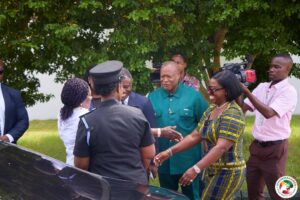
The Vice President of Ghana, Jane Naana Opoku-Agyemang, has lauded the progress of the Ghana Medical Trust Fund following a working visit to the institution, describing its work as critical to improving healthcare delivery across the country.
During the visit, the Vice President engaged with officials of the Fund to gain firsthand insight into its operations, systems, and ongoing initiatives. She was taken through key milestones achieved so far, including the development of operational structures and the implementation of frameworks aimed at enhancing access to quality healthcare.
Addressing the team, Prof. Opoku-Agyemang подчеркed the significance of the Fund’s mandate, noting that its role sits “at the centre of how care must reach Ghanaians everywhere.” She emphasized the need for increased public awareness of the initiative, stating that its impact must be communicated more widely.
The Vice President also commended the leadership of Adjoa Obuobia Darko-Opoku and her team for what she described as a clear strategic direction and an impressive pace of execution. She acknowledged their efforts in building a robust system capable of delivering meaningful outcomes in the health sector.
Also present at the meeting was the Minister for Health, Kwabena Mintah Akandoh, whose continued support, according to officials, has been instrumental in advancing the work of the Fund.
Officials of the Ghana Medical Trust Fund expressed gratitude for the visit, describing it as both encouraging and timely. They noted that the Vice President’s endorsement provides renewed momentum as the institution intensifies its efforts to expand its reach and impact in the months ahead.
The visit is expected to further strengthen collaboration between key stakeholders and reinforce the government’s commitment to building a resilient and inclusive healthcare system for all Ghanaians.
[06/05, 12:02 pm] sarpongwilliam24: VEHICLE OWNERSHIP CHANGE – DVLA
The Driver and Vehicle Licensing Authority wishes to clarify the proper legal procedure for change of ownership or registration of vehicles where the seller or importer cannot be located.
The DVLA is established as a statutory authority responsible for maintaining an accurate register of vehicles and their registered owners. The Authority does not determine disputes relating to ownership of property and for that matter vehicle. Vehicle registration reflects lawful ownership but does not create it. Consequently, where the registered owner has not executed the necessary transfer documentation, or where the importer named in customs documentation has not completed lawful registration, the DVLA cannot unilaterally alter its records without legal authority.
Under the Sale of Goods Act, there is an implied condition in every contract of sale that the seller has the right to sell the goods and will pass good title to the buyer. The seller is legally bound to convey lawful ownership and ensure that the buyer enjoys quiet possession. Where a seller fails in this duty, the remedy lies against that seller. The law further provides, through the doctrine of nemo dat quod non habet, that a person cannot transfer better title than he possesses.
Accordingly, where a purchaser is unable to trace the person from whom a vehicle was acquired, the appropriate course of action is to institute proceedings against that seller seeking a declaration of ownership or a vesting order. If the seller cannot be located after reasonable efforts, the court may grant substituted service, including publication. Upon consideration of evidence of purchase, payment, possession, and due diligence in attempting to locate the seller, the court may grant the necessary orders declaring the purchaser to be the lawful owner.
Once such an order is issued, the DVLA will give full effect to it in accordance with the law. In some instances, the Authority may be joined as a second defendant solely for the purpose of implementing the court’s final determination.
Most often however, people who are unable to locate the person from whom they purchase the vehicle rather initiate proceedings against only DVLA. This procedure is not advisable in the sense that anytime somebody comes afterwards to challenge the order of court, the person will surely succeed.
Members of the public are advised to exercise due diligence before purchasing any vehicle. Prospective buyers should ensure that the seller has proper title, that registration documents are authentic and complete, and that all statutory requirements have been satisfied. Taking these precautions will prevent future disputes and safeguard purchasers’ legal rights.
The DVLA remains committed to upholding the law, maintaining the integrity of the national vehicle register, and ensuring that all changes of ownership are effected in accordance with due process.