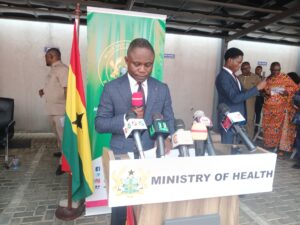
The Minister for Health, Kwabena Mintah Akandoh, has inaugurated Advisory Boards for Nursing and Midwifery Training Colleges across Ghana, describing the move as a critical step toward strengthening the governance and quality of health professional education in the country.
Speaking at the ceremony, the Minister stressed that the development of a resilient healthcare system depends largely on the calibre of professionals trained within the country’s health institutions. He noted that while infrastructure and medical equipment remain important, the effectiveness of the health sector ultimately hinges on the competence and preparedness of its workforce.
He said the inauguration of the boards signals government’s commitment to improving standards, leadership, and long-term planning within health training institutions, which he described as the foundation of Ghana’s healthcare delivery system.
Highlighting key policy directions under the Mahama administration, the Minister revealed that government is prioritising specialised nursing training to meet the growing complexity of healthcare needs. In collaboration with the Ghana Medical Trust Fund and the University of Cape Coast, six post-basic Bachelor of Science programmes have been introduced. These include Cardiology, Critical Care, Endocrinology, Nephrology, Oncology and Emergency Nursing.
He explained that the initiative is aimed at producing a new generation of nurses equipped with specialised skills to support advanced healthcare delivery and address the rising burden of non-communicable diseases and emergency cases.
The Minister further disclosed that government is progressing steadily toward upgrading Health Training Institutions to degree-awarding status. According to him, about 42 colleges have completed the necessary assessments and are awaiting accreditation to begin offering Bachelor of Science programmes.
To improve the quality of teaching, he announced that scholarship opportunities have been secured for tutors to pursue PhD studies, a move expected to deepen academic excellence and strengthen research capacity within the institutions.
On trainee welfare, the Minister assured that nursing trainee allowances are now being paid regularly, easing financial pressure on students. He also highlighted the implementation of the government’s “No-Fee-Stress” policy, which removes first-year academic fees for tertiary students, including nursing trainees, to improve access to education.
However, the Minister issued a strong warning to principals of training colleges, urging strict adherence to approved admission quotas and accreditation requirements. He cautioned that any principal who admits unqualified numbers or runs unapproved programmes will face disciplinary action, stressing that such practices undermine quality assurance and national planning.
Addressing members of the newly inaugurated Advisory Boards, the Minister charged them to uphold transparency, accountability, and high academic standards in their oversight roles. He urged them to remain guided by the broader goal of improving healthcare delivery for all Ghanaians.
He concluded by expressing confidence that with commitment, collaboration and integrity, the boards will help build stronger institutions capable of producing skilled and compassionate health professionals for the country.