The Ghana Revenue Authority (GRA) has confiscated a consignment of transit goods intercepted earlier this year and interdicted four Customs officers after investigations uncovered widespread fraud, falsified documentation and attempts to divert the cargo into Ghana’s local market. https://www.ghanaweb.com/
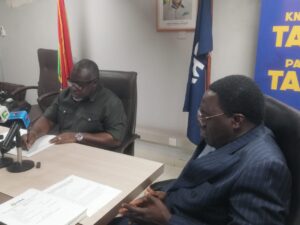
Addressing a media briefing in Accra on Tuesday, Commissioner-General Anthony Kwasi Sarpong said investigations into the February 2026 interception of 18 trucks had revealed serious breaches of customs procedures involving false declarations, under-declaration of goods, tariff manipulation and suspected impersonation.
The trucks, declared as transit cargo from Togo through Ghana to Niger, were intercepted near the Kpone barrier by a joint team of GRA Customs preventive officers and National Security personnel following suspicions that the goods were intended for the Ghanaian market.
Read Also: Zoomlion Deploys Heavy Equipment for Ashanti Sanitation Campaign
Mr. Sarpong explained that a committee established to investigate the incident reviewed reports from arresting officers, statements from Customs officials, freight agents, drivers, escort officers, e-tracking personnel and declarants. The committee also re-examined the seized goods, engaged the Nigerian Chamber of Commerce and sought information from Togolese Customs authorities.
According to the Commissioner-General, the investigation established that export documents obtained from Togolese Customs showed the cargo originated from Malaysia and Indonesia, arrived through the Port of Lomé and was originally destined for two companies in Abidjan, Côte d’Ivoire—not Niger as declared to Ghanaian authorities.
He disclosed that the declaration submitted at the Akanu border was not supported by authentic bills of lading or export documents but instead relied on invoices claiming the goods had been purchased from the open market in Togo.
The investigation further uncovered significant discrepancies in the quantity and description of the cargo. While Customs records declared 35,246 jerry cans of vegetable cooking oil, physical examination revealed 39,256 jerry cans, indicating an under-declaration of 4,010 units.
Officials also found that products declared as tomato paste were in fact tomato seasoning, a misdescription that affected the customs valuation of the goods.
Mr. Sarpong said investigators also identified deliberate tariff manipulation after the cooking oil was classified under a tariff attracting a 20 percent import duty instead of the correct classification, which carries a 35 percent duty, thereby substantially reducing the required bond guarantee.
Further investigations raised concerns over the identity of the declared consignee after the Nigerian Chamber of Commerce could not verify the taxpayer identification details provided for the consignee, Adamu Mumuni.
The Commissioner-General revealed that a review of Customs records uncovered 44 previous transit declarations linked to the same consignee, many of which exhibited similar irregularities, suggesting that the attempted diversion may have formed part of a broader pattern of fraudulent transit operations.
As part of disciplinary measures, four Customs officers who handled the transaction have been interdicted and are undergoing internal disciplinary proceedings.
Based on the findings, GRA has confirmed the confiscation of the entire consignment.
Mr. Sarpong announced that, under the direction of the Ministry of Finance, the seized goods will be allocated to the National School Feeding Programme to support government efforts to improve nutrition among schoolchildren.
He added that investigations are continuing into the activities of the clearing agent and any other persons found culpable would face sanctions in accordance with the law.
The Commissioner-General assured the public that GRA had strengthened compliance measures at border posts to safeguard revenue and combat illicit trade.
He urged importers, freight forwarders and the trading community to comply fully with customs regulations, warning that the Authority would not hesitate to enforce the law against individuals or businesses involved in smuggling, fraud or other customs offences.